This week we have time to do a Time Line with all the topics of the presentations of all of us.
So, we have to do in groups a time line of: ancient civilizations, greece, Rome, Middle Ages, the enlightenment, new school, deschooling and emancipation.
viernes, 16 de febrero de 2018

9/1/18 NEW SCHOOL
Today we have the presentation of new school and progressive education.
First of all we have to know that it was born at the end of XIX in almost Europe and some countries of America and Asia.
After the world wars, UNESCO appears, with general purposes like:
- democrization of education
- refinement of institutions
- rational and technical organisation
- general objectives of education to reduce tensions between people
- respect traditions
- exchange of information and qualified people for the progress of science and the arts
Also, we can appreciate the primary contents in this movement: linguistic communication, mathematical, science and technology, digital, learn to learn, social and civic, sense of initiative and enterprising spirit and conscience and cultural.
The aims of this movement are: school community, cultural diversity, student creativity, educational quality and student self-esteem.
Maria Montessori is an important author of this movement.
First of all we have to know that it was born at the end of XIX in almost Europe and some countries of America and Asia.
After the world wars, UNESCO appears, with general purposes like:
- democrization of education
- refinement of institutions
- rational and technical organisation
- general objectives of education to reduce tensions between people
- respect traditions
- exchange of information and qualified people for the progress of science and the arts
Also, we can appreciate the primary contents in this movement: linguistic communication, mathematical, science and technology, digital, learn to learn, social and civic, sense of initiative and enterprising spirit and conscience and cultural.
The aims of this movement are: school community, cultural diversity, student creativity, educational quality and student self-esteem.
Maria Montessori is an important author of this movement.
8/1/18 THEORIES OF EMANCIPATION
Today in class we were learning about emancipation.
We have to know that it arises from World War II. It attaches great importance to the person as the centre of the world in a historical context.
Education becomes an exercise of awareness of personal and social reality to eradicate illiteracy and ignorance. Also, education must develop to the maximum potential of the individual because the student is a person of unfinished nature.
Will and affectivity are qualities of the person that are above intelligence.
The most important author who talks about emancipation is Paulo Freire.
The practical part was about questions and answers in Kahoot.
We have to know that it arises from World War II. It attaches great importance to the person as the centre of the world in a historical context.
Education becomes an exercise of awareness of personal and social reality to eradicate illiteracy and ignorance. Also, education must develop to the maximum potential of the individual because the student is a person of unfinished nature.
Will and affectivity are qualities of the person that are above intelligence.
The most important author who talks about emancipation is Paulo Freire.
The practical part was about questions and answers in Kahoot.
15/12/17 DESCHOOLING
Today the presentation was about deschooling.
First of all we have to know that deschooling proposes an education alternative of homeschooling. Also, it does not mean to stop learnings and it is not legal in Spain.
Self-directed education is the key element for unschooling to ocurr.
The methods it include are, for example: playing, household responsibilities, personal interest, internship and work experience, travelling, books ...
We can appreciate two important authors. The first one is Ivan Illich, who want to replace the school as a large knowledge back by a technological institutions in which everyone would have credit. It would be posible thanks to the media.
The other important author is Paul Goodman. He talks about school not compulsory and school decentralization.
To conclude the presentation, our classmates did a kahoot to improve the contents.
5/12/17 MUSEUM OF EDUCATION UCM
Today our class visited the museum of education in the complutense university of madrid.
We had a guide and he presented to us all the instruments and materials that teacher used many years ago.
For me was a trip really interesting because we saw a lot of thing such us books, games...
Also we learnt the school rules of the past and the role of the woman in the school.
At last, we saw Montessori`s games for children.
I want to come back soon!

We had a guide and he presented to us all the instruments and materials that teacher used many years ago.
For me was a trip really interesting because we saw a lot of thing such us books, games...
Also we learnt the school rules of the past and the role of the woman in the school.
At last, we saw Montessori`s games for children.
I want to come back soon!
4/12/17 MONTESSORI
Our classmate Pablo did today a presentation about a woman who is really important in the education context. Her name is Montessori.
We learnt Montessori`s methodology because she created her personal one: it was based in 4 features.
- Learn interesting things.
- Children have to learn by their own.
- Learn through experience
- Children have specific skills
To practice this, Pablo asked us a lot of questions and it was really funny. I enjoyed it!

We learnt Montessori`s methodology because she created her personal one: it was based in 4 features.
- Learn interesting things.
- Children have to learn by their own.
- Learn through experience
- Children have specific skills
To practice this, Pablo asked us a lot of questions and it was really funny. I enjoyed it!
28/11/17 THE ENLIGHTENMENT
Today our classmates did the presentation of the enlightenment. It was really interesting and very useful.
First of all they explain the theorical part with prezzi.
We learnt that was a cultural time in Europe during the XVII-XVIII centuries. Also, they explained politics and economics in Europe, America and Spain.
An other important point of the presentation was the education in England, France and Spain. We saw that there were a lot of differences in each country.
To conclude the presentation, they talked about 6 authors:
- Voltaire
- Locke
-Rousseau
- Luzuriaga
-Feijoo
-Capmany
The practical part was a game with questions and also they did a Kahoot.
We were playing very motivated because the winner won a packet of candies.

First of all they explain the theorical part with prezzi.
We learnt that was a cultural time in Europe during the XVII-XVIII centuries. Also, they explained politics and economics in Europe, America and Spain.
An other important point of the presentation was the education in England, France and Spain. We saw that there were a lot of differences in each country.
To conclude the presentation, they talked about 6 authors:
- Voltaire
- Locke
-Rousseau
- Luzuriaga
-Feijoo
-Capmany
The practical part was a game with questions and also they did a Kahoot.
We were playing very motivated because the winner won a packet of candies.

martes, 13 de febrero de 2018
21/11/17 ROME.
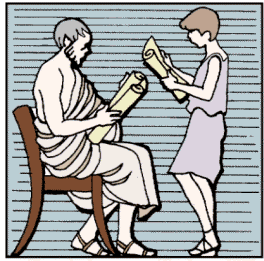
Today was Rome’s turn. Our friends presented it with a good presentation and interesting things about education in Rome.
We learnt the periods of the Roman empire, and algo all the features. Also:
- Elemental education (7-12 years)
Reading, writing and arithmetic
- Secundary school (10-16 years)
Study of gramatical theory, Reading classical Greek and Latin authors
and commenting on the text
- Further education (17-20 years)
discurses about historical topics
The last thing they explained were Authors: ciceron, plautarco, quintiliano...
We learnt the periods of the Roman empire, and algo all the features. Also:
- Elemental education (7-12 years)
Reading, writing and arithmetic
- Secundary school (10-16 years)
Study of gramatical theory, Reading classical Greek and Latin authors
and commenting on the text
- Further education (17-20 years)
discurses about historical topics
The last thing they explained were Authors: ciceron, plautarco, quintiliano...
20-21/11/17 GREECE.
Hi friends.
Today was my turn. My group and I did our presentation. As you know, our work was about education in GREECE.
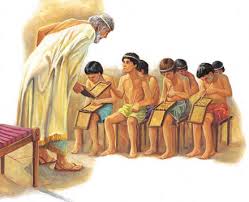
First of all, we have done a review of greece's context and background. Then, we have spoken about the context and methodology. In greece, was given grammarian, musical education, gymnastic and pederasty. Then, we have spoken about education in Sparta and in Athens. Some representative authors like Plato, The Sophists, and Aristotle and to conclude we have spoken about the movement at the present.
To practice the presentation, we did a game: KAHOOT. It was really funny and the winner was Itziar.

Today was my turn. My group and I did our presentation. As you know, our work was about education in GREECE.
First of all, we have done a review of greece's context and background. Then, we have spoken about the context and methodology. In greece, was given grammarian, musical education, gymnastic and pederasty. Then, we have spoken about education in Sparta and in Athens. Some representative authors like Plato, The Sophists, and Aristotle and to conclude we have spoken about the movement at the present.
To practice the presentation, we did a game: KAHOOT. It was really funny and the winner was Itziar.
17/11/17 ANCIENT CIVILIZATIONS.
Welcome to my blog!!!!
Today we have started the presentatios that we were preparing these weeks. The first group has been Ancient Civilizations.
Today we have started the presentatios that we were preparing these weeks. The first group has been Ancient Civilizations.
We learnt that we can talk about 3 groups in this period of time. The first is India (3000 b.C- 1500 b.C). Here we can apreciate the Aryans and all the cultural changes introduced by them. They have important subjects such us four vedas, six vedangas, puranas.... There were authors like: Vyasa.
The second civilization was Egypt. It has 3 periods: old empire, middle empire and new empire. Here education began al 4 and there were educational ranks.
The last civilization they explained was Mesopotamia. Here we can talk about Sumerians and Scribes.
In the practise of the work, they did a game with a virtual glasses. We used our mobile phones and with the glasses we saw photos of the civilizations while we were listening the explication.
It was really funny!!!!!
Suscribirse a:
Comentarios (Atom)